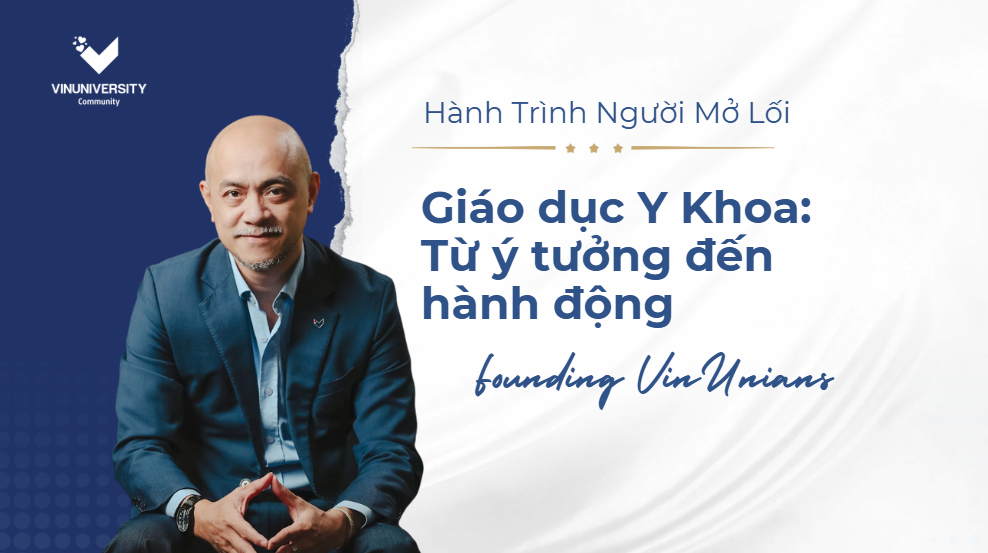
Medical Education from Idea to Action
March 27, 2025
Sharing from Assoc. Prof., PhD, MD Lê Cự Linh – Executive Vice Dean, College of Health Sciences, VinUniversity
The Beginning at VinUni
VinUni’s story began in late 2014, when Vinmec proposed establishing a medical university to address the challenge of recruiting high-quality healthcare professionals, while also elevating the Group’s healthcare mission. When I was invited to join, I accepted right away, because the idea aligned closely with my own desire to contribute. At that time, the Group’s Chairman set three strategic goals: to build a world-class medical university, to develop it following a research-university direction, and to tackle the health issues of Vietnamese people. By 2016, the project expanded into a comprehensive university, adding programs in management, technology, and science to build a holistic education ecosystem. In 2017, these two projects were merged and officially became VinUni, with the mission of improving education quality and contributing to the advancement of Vietnam’s domestic healthcare system.
Previously, I had contributed significantly to building Vietnam’s first public health university, but in medicine and nursing, I had never had the opportunity to help design an education program from the ground up. That is why I had long hoped that healthcare education would undergo a major reform, starting from training institutions, to create a high-quality workforce for the future. When I was invited to join Vingroup, I saw it as a chance to pursue big dreams – things I had wanted to do throughout nearly 20 years of working in the public system. Vingroup’s leadership, especially the Chairman, had a very clear vision, and I felt that vision matched mine completely. I also dreamed of building a university that meets international standards, and this was the opportunity to do what I had always aspired to do.
My life principle is: if you don’t try, you will never know what you are capable of. Only by daring to challenge yourself and stepping out of your comfort zone can you fully discover your potential. That belief guided me to accept the invitation to join VinUni, a place where I saw the opportunity to help create breakthrough value for medical education in Vietnam.
Major Challenges
The process of building VinUni came with many challenges. Financially, it’s not that we lacked resources, but it would also be inaccurate to say we had unlimited funding. Everything had to be carefully calculated, every amount carefully managed, and budgets planned in detail. However, I do not consider this the biggest difficulty. The greatest challenge was people. To build a new educational environment, we needed people with vision, ambition, and a willingness to face challenges. There are many highly capable professionals in healthcare, from doctors and surgeons to nurses, but convincing them to join a new project in a completely new environment was far from easy. These individuals already had stable careers and good incomes, and understandably, they did not want to trade their current positions for a project that might not succeed. In particular, many had concerns about the project’s sustainability – about whether Vingroup could truly maintain an international-standard university in the long term. This created doubt and made it difficult to find partners who truly aligned with VinUniversity’s vision.
In addition, working with government agencies, handling legal procedures, and convincing international partners was another demanding journey. When VinUni existed only as a paper proposal, persuading UPenn – an Ivy League university ranked among the global top 15 in medicine and a leader in nursing – to partner with us was an extremely difficult task. Even once collaboration began, differences in specific operating approaches required ongoing efforts to harmonize. VinUni did not “import” an American curriculum as-is, but instead built an international medical school that fits Vietnam’s realities. Students also study from classic professional textbooks (for example, Gray’s Anatomy in Anatomy) with lectures supported by Penn’s instructional design, yet the content still needed Vietnamese faculty to adjust it to fit the domestic situation. Medical education is not only about medical knowledge; it also requires understanding culture, healthcare systems, and legal procedures in each country. Currently, our Year 5 medical students are preparing for a mock exam based on U.S. standards next summer. Penn experts have highly praised their intelligence and capability. VinUni is not just a school; it is a demanding journey of blending international standards with Vietnamese identity.
In the past, we traveled to many places to learn, including the National University of Singapore (NUS), which partners with Duke University (USA) to run a US-style medical program. When I visited classrooms applying team-based learning, I was truly impressed. And when I spoke with their program leadership team, I was genuinely overwhelmed. Their 4-year medical program requires more than 1,000 instructors to operate—including doctors and specialists across many fields such as internal medicine, surgery, obstetrics, pediatrics, and more. They do not only have full-time teachers; they also have professionals who teach just a few sessions, or a few dozen sessions per year. Mobilizing such a massive workforce to build and run the program is truly remarkable. Today, we are on a similar path. At VinUni, in addition to several dozen full-time faculty members who form the core of the College of Health Sciences, we also have more than 500 doctors and healthcare experts from leading hospitals such as Vinmec, 108 Military Central Hospital, the National Children’s Hospital, and others – and this number continues to grow. It is difficult and demanding, but I find it a fascinating journey, because it proves that creating an internationally worthy medical program requires tremendous dedication and close coordination.
One unforgettable memory was our visit to the MSR National Simulation Center in Israel, a center that advises top medical schools worldwide, including Columbia, New York, and Mayo Clinic. When I returned, I was determined to bring that model to Vietnam. The first time I tried to persuade stakeholders, the timing was not right. Two years later, when we began building VinUni’s medical school, I brought Vinmec’s leadership to MSR, presenting a detailed plan. On our flight back, while transiting in Bangkok, we sent an investment proposal worth tens of billions of VND to the Group Chairman, and received approval immediately upon landing in Hanoi. That trip not only enabled us to sign the partnership with MSR, but also laid the foundation for VinUni’s simulation center, from building design and technical systems to workforce training strategy. Although VinUni’s campus only broke ground in the second half of 2018, the simulation center had already been planned since 2017, ensuring we were always one step ahead. That was truly something special.
Looking Back on Five Years of Development
Looking back on VinUni’s five-year development journey and the years I have accompanied it, there are two things I feel most clearly proud of.
First is the team I built, people who worked with me to accomplish incredibly difficult tasks, such as designing the curriculum and establishing the College of Health Sciences. This is the first college in Vietnam to achieve international accreditation recognition. For example, the nursing program led by Assoc. Prof. Nguyễn Hoàng Long passed two rounds of review by the Accreditation Commission for Education in Nursing (ACEN), with the second round being Candidacy, almost officially preparing for recognition in the final stage. This will be the first and only program in Vietnam to be accredited by ACEN in nursing, something no other Vietnamese university has achieved.
In addition, VinUni was granted permission by the Ministry of Health to train the Medical Residency program (BSNT) even when the University had not yet graduated any medical students. This was not easy, because residency training is highly demanding and requires strict evaluation. However, we received approval from the Ministry of Health as early as our preparation to launch the medical program in 2020, and we welcomed the first cohort in October 2020. With that foundation, we were highly determined to ensure residency training quality. VinUni has become the only institution in Vietnam to achieve ACGME-I accreditation for the institution-level residency program (in 2023) and program-level accreditation for three specialties – Internal Medicine, Surgery, and Pediatrics (in 2024).
Second, I feel proud when I see my students, especially nursing students, being warmly welcomed by the job market. Recently, in June 2024, VinUni’s first nursing bachelor cohort graduated, and most were hired by Vinmec. Some chose to work with international NGOs, and one was admitted to a master’s program at Harvard. Those recruited by Vinmec received strong praise from leadership at Times City, who evaluated them as highly capable and sharp. Vinmec leadership also promised to create favorable career opportunities for them, not only in professional roles but also in management and leadership pathways. This makes me deeply proud. VinUni’s residents have also been very successful: trained under US international standards, they were hired by Vinmec right after graduation, with good income and clear promotion opportunities.
Loving Messages and Wishes
As VinUni steps into 2025 and celebrates its 5th anniversary, I would like to send my wishes to all generations of faculty members, staff, students, and parents, both present and future, of VinUniversity.
To all professors, lecturers, and colleagues in management and program operations, I hope you will always keep your passion alive and your desire to contribute to the University’s development. We will continue to care for and accompany our students, improve and enhance the quality of our training programs, and create a truly excellent environment for learning and research. Wishing everyone a successful new year, especially in the upcoming admissions season and in supporting students as they graduate.
To students, I hope you will always pursue the career path that feels meaningful to youwhether in clinical practice, research, management, or leadership. I hope you find passion in what you do and create positive impact for society. I wish you become people of value, contributing to healthcare systems not only in Vietnam, but also regionally and internationally.
To parents, I hope you will continue to trust your children’s learning journey and not feel overly worried or impatient. I understand that medical education is complex and requires deep expertise, so parents outside the healthcare field may not always fully understand it. However, I believe that when parents stay connected and closely engaged with the University, you will gradually understand and feel the investment and dedication we put into your children—and develop stronger trust in the University. We always respect and listen to parents’ feedback, and we will do our very best to ensure students have the best possible career development pathway.
Wishing everyone a new year filled with health, happiness, and success. Together, we will continue building a strong VinUni and moving forward sustainably.